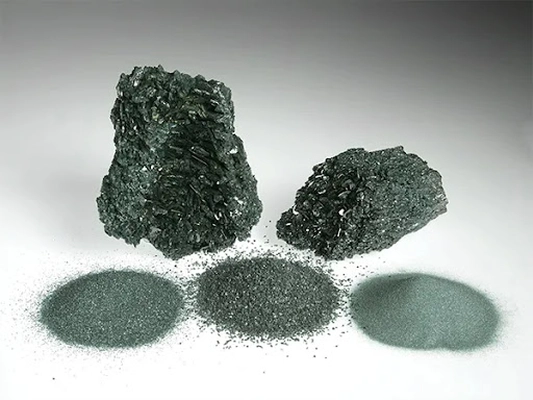
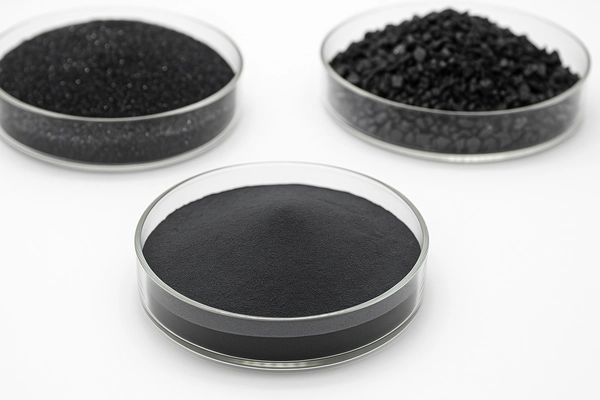
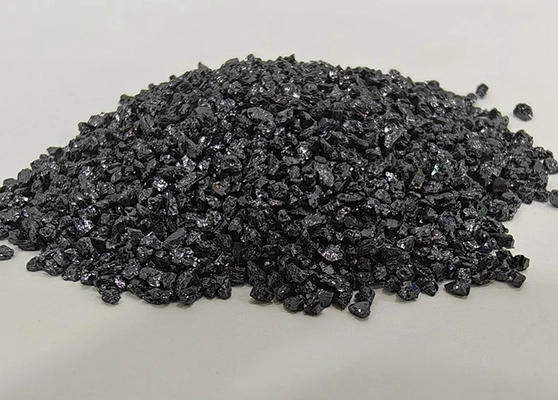
Silicon carbide grit and powder are abrasive materials used for grinding, blasting, lapping, polishing, refractory production, ceramics, surface preparation, and other industrial applications. Although both are made from silicon carbide, the terms grit and powder generally describe different particle-size ranges and end-use requirements.
Quick Answer
Silicon carbide grit generally refers to coarser, precisely graded silicon carbide abrasive particles used for applications such as blasting, grinding, cutting, surface preparation, and refractory products. Silicon carbide powder generally refers to finer particles used where controlled particle size and finer surface finishes are required, including lapping, polishing, technical ceramics, and precision processing.
The correct material cannot be selected by the terms “grit” or “powder” alone. Industrial buyers should also consider particle size, FEPA grade, micron range, silicon carbide type, purity, particle shape, and the actual processing application.
What Is Silicon Carbide Grit?
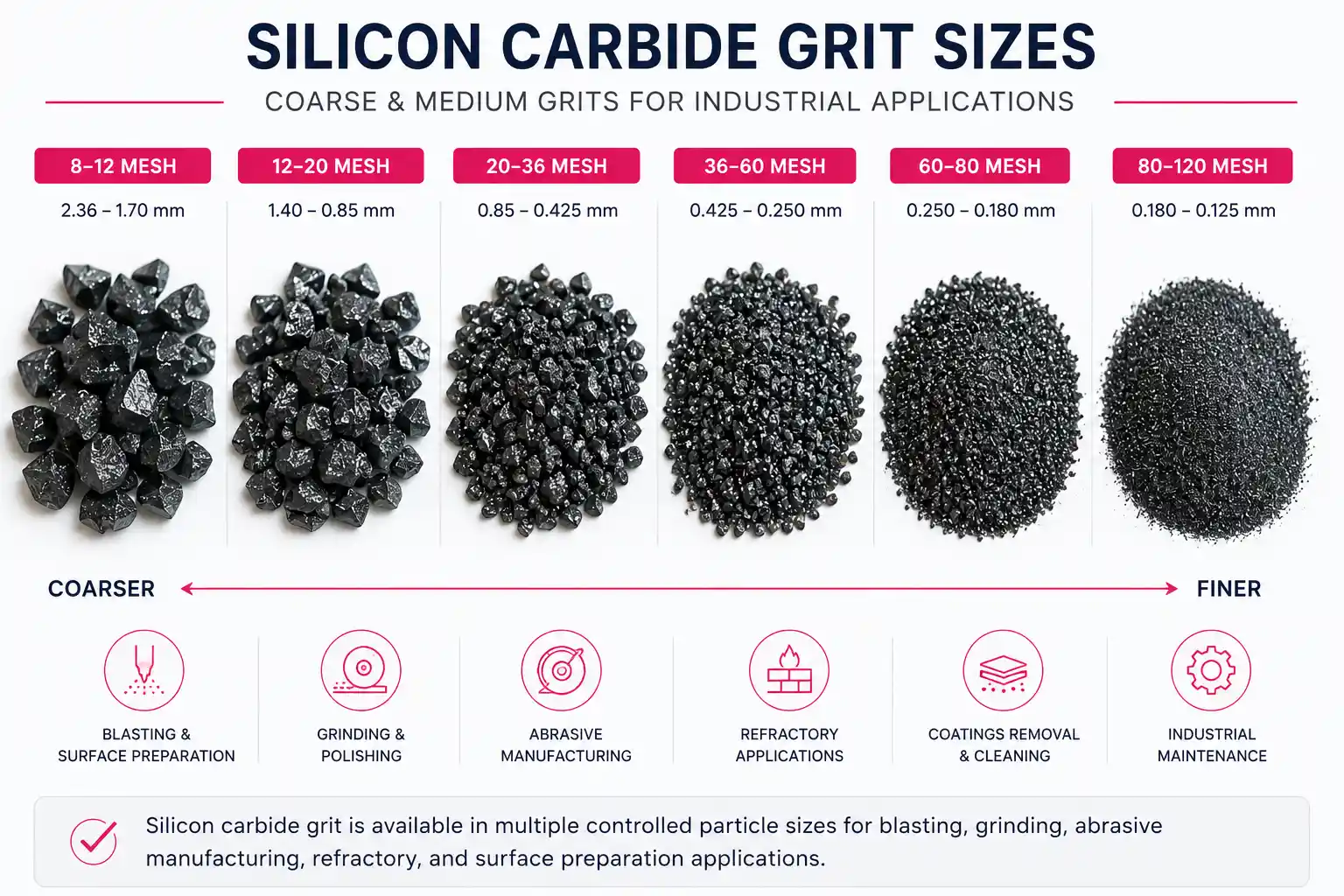
Silicon carbide grit is a synthetic abrasive material consisting of hard, sharp silicon carbide particles that have been crushed and classified into controlled particle-size ranges.
Because silicon carbide combines high hardness with sharp cutting edges, grit grades are commonly selected when an application requires aggressive material removal, controlled surface preparation, or abrasive action against hard materials.
Typical applications include:
- Abrasive blasting and surface preparation
- Grinding and cutting
- Bonded and coated abrasive manufacturing
- Stone and glass processing
- Rock tumbling
- Refractory products
- Technical ceramic production
However, “silicon carbide grit” is not a single specification. Different applications can require substantially different particle sizes, chemical compositions, and silicon carbide grades.
For example, a coarse grit selected for aggressive blasting would not normally be the same specification used for precision finishing. This is why industrial buyers should identify both the required grit size and application when sourcing silicon carbide abrasives.
For a more detailed explanation of grit classification and industrial uses, see our What Is Silicon Carbide Grit? guide.
What Is Silicon Carbide Powder?
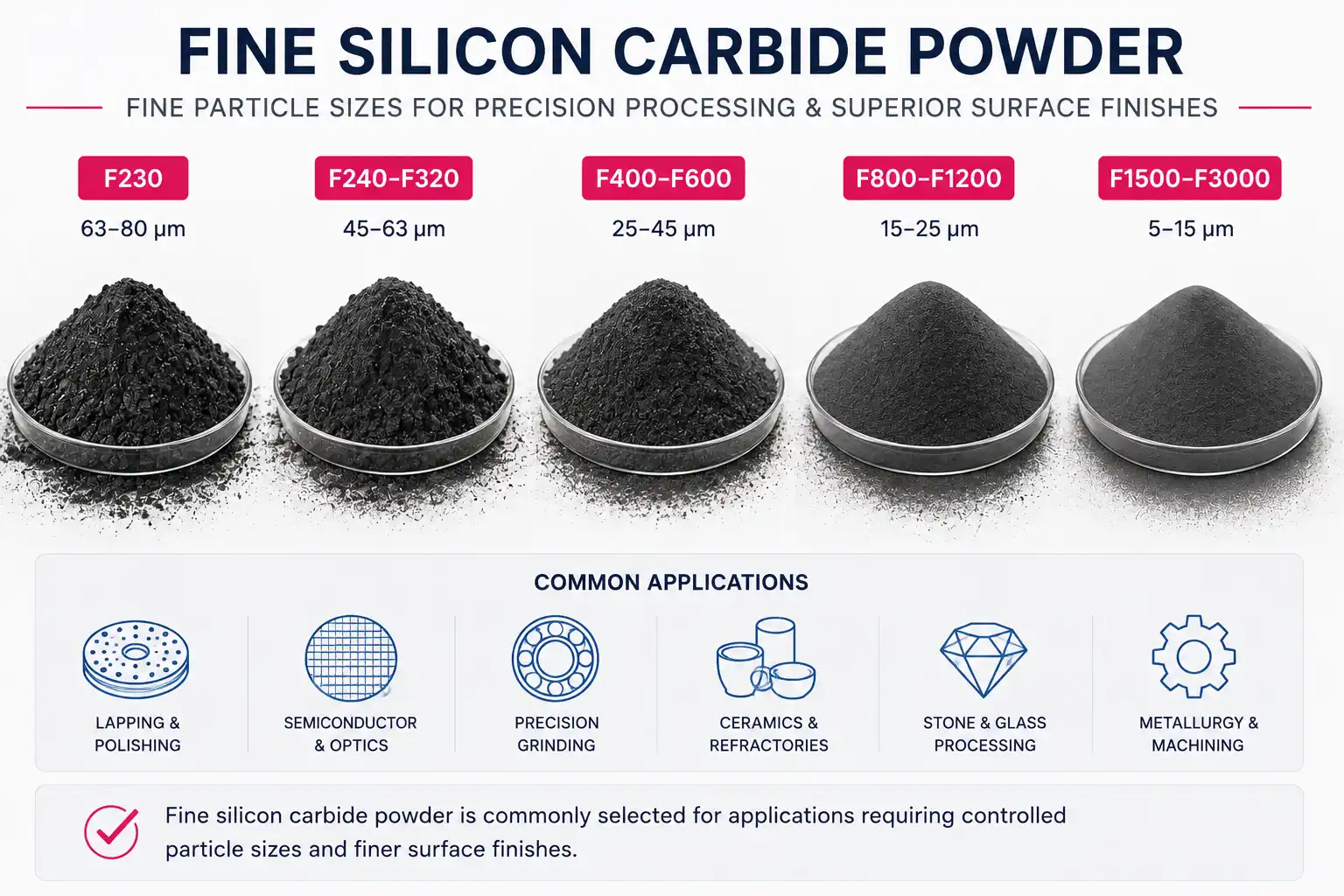
Silicon carbide powder refers to finer silicon carbide particles produced through crushing, milling, classification, and particle-size control processes.
Compared with coarse abrasive grit, silicon carbide powder is commonly selected for applications where particle-size distribution and surface finish are more important than aggressive stock removal.
Typical applications include:
- Precision lapping
- Surface polishing
- Glass processing
- Advanced ceramics
- Refractory formulations
- Composite materials
- Specialized industrial fillers
- Precision surface finishing
Fine silicon carbide powders may be specified by FEPA grit designation, micron range, particle-size distribution, or another customer-specific specification. For this reason, terms such as “fine silicon carbide powder” are often not precise enough for industrial purchasing.
A buyer should normally provide the required particle size together with the application and, where necessary, additional technical requirements such as chemical composition or particle-size distribution.
See our What Is Silicon Carbide Powder? guide for a deeper explanation of powder grades, properties, and applications.
Silicon Carbide Grit vs. Powder: What Is the Difference?
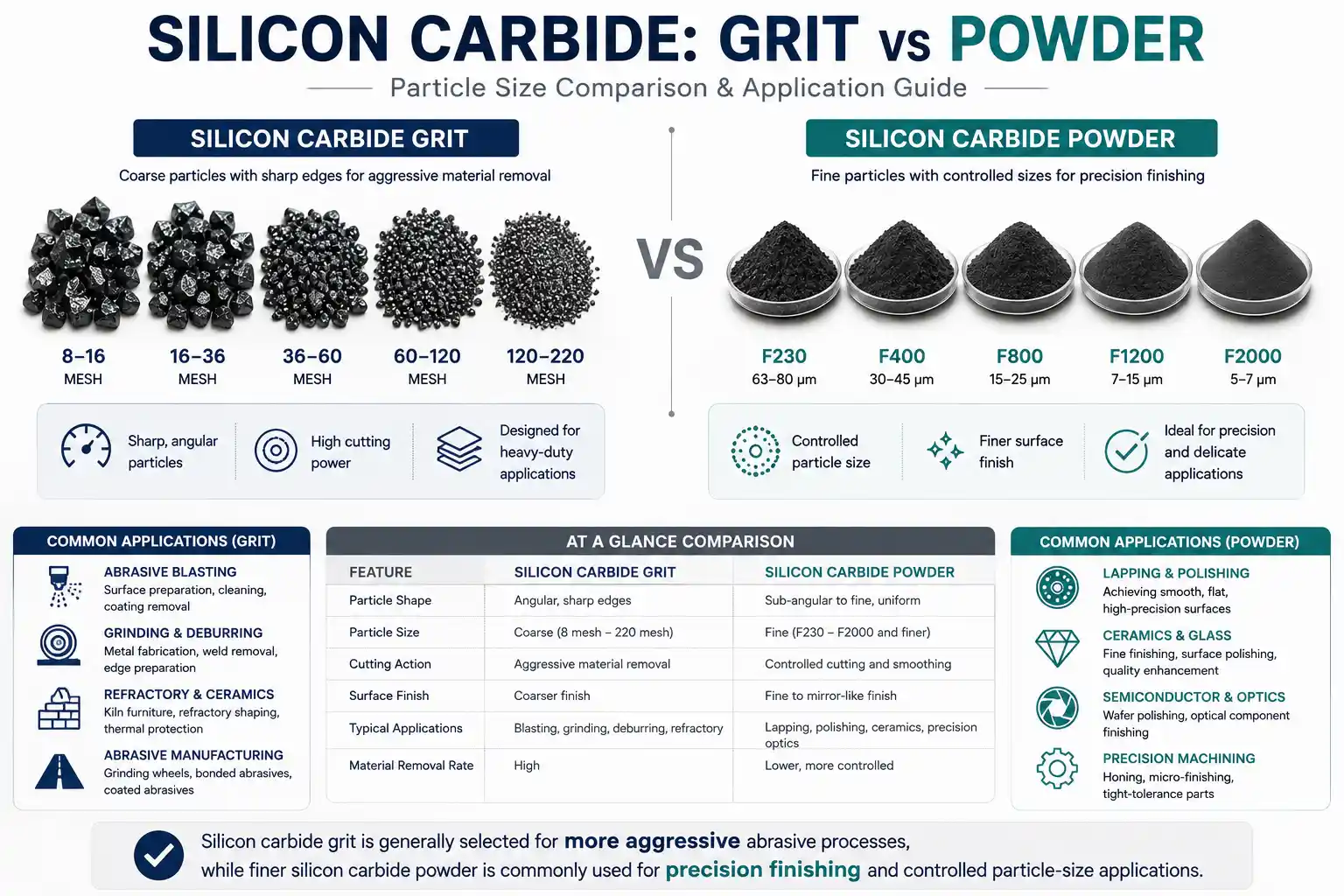
The main practical difference between silicon carbide grit and silicon carbide powder is particle size and intended application. Grit generally describes coarser abrasive particles, while powder usually describes finer particles used for precision processing.
| Factor | Silicon Carbide Grit | Silicon Carbide Powder |
|---|---|---|
| Typical Particle Size | Coarser | Finer |
| Primary Function | Material removal and abrasive cutting | Fine finishing and precision processing |
| Blasting | Common | Less common |
| Grinding | Common | Application dependent |
| Lapping | Application dependent | Common |
| Polishing | Limited for fine finishing | Common |
| Refractories | Common | Common |
| Technical Ceramics | Application dependent | Common |
| Important Purchasing Parameter | Grit size and application | Particle size distribution and application |
The distinction is useful for understanding the products, but buyers should not rely exclusively on the words “grit” and “powder.” The actual particle-size specification should always be confirmed.
For example, different suppliers, industries, and standards may describe fine abrasive material differently. A specific FEPA designation or micron requirement provides much more useful purchasing information than simply requesting “fine silicon carbide powder.”
For a detailed comparison, read Silicon Carbide Grit vs. Powder: What's the Difference?.
Black vs. Green Silicon Carbide Grit and Powder
Silicon carbide grit and powder are commonly available as black silicon carbide and green silicon carbide. Both belong to the silicon carbide family, but differences in purity, production conditions, properties, and cost make them suitable for different industrial requirements.
| Property | Black Silicon Carbide | Green Silicon Carbide |
|---|---|---|
| Typical Positioning | General industrial abrasive and refractory applications | Higher-purity and precision applications |
| Relative Purity | High | Generally higher |
| Relative Cost | More economical | Generally higher |
| Grinding | Widely used | Used where higher purity or specific performance is required |
| Blasting | Widely used | Possible but often unnecessary economically |
| Refractories | Widely used | Application dependent |
| Precision Processing | Available | Often preferred for demanding applications |
Black silicon carbide is commonly selected for general grinding, abrasive blasting, refractory materials, and other industrial applications where strong cutting performance and cost efficiency are important.
Green silicon carbide is generally associated with higher purity and is often selected for precision grinding, fine powders, ceramics, and applications with stricter material requirements.
The better choice therefore depends on the application rather than color alone.
Buyers comparing the two materials can continue to our Black vs. Green Silicon Carbide technical comparison.
For commercial specifications and available grades, see our Black Silicon Carbide and Green Silicon Carbide product pages.
Silicon Carbide Grit Sizes Explained
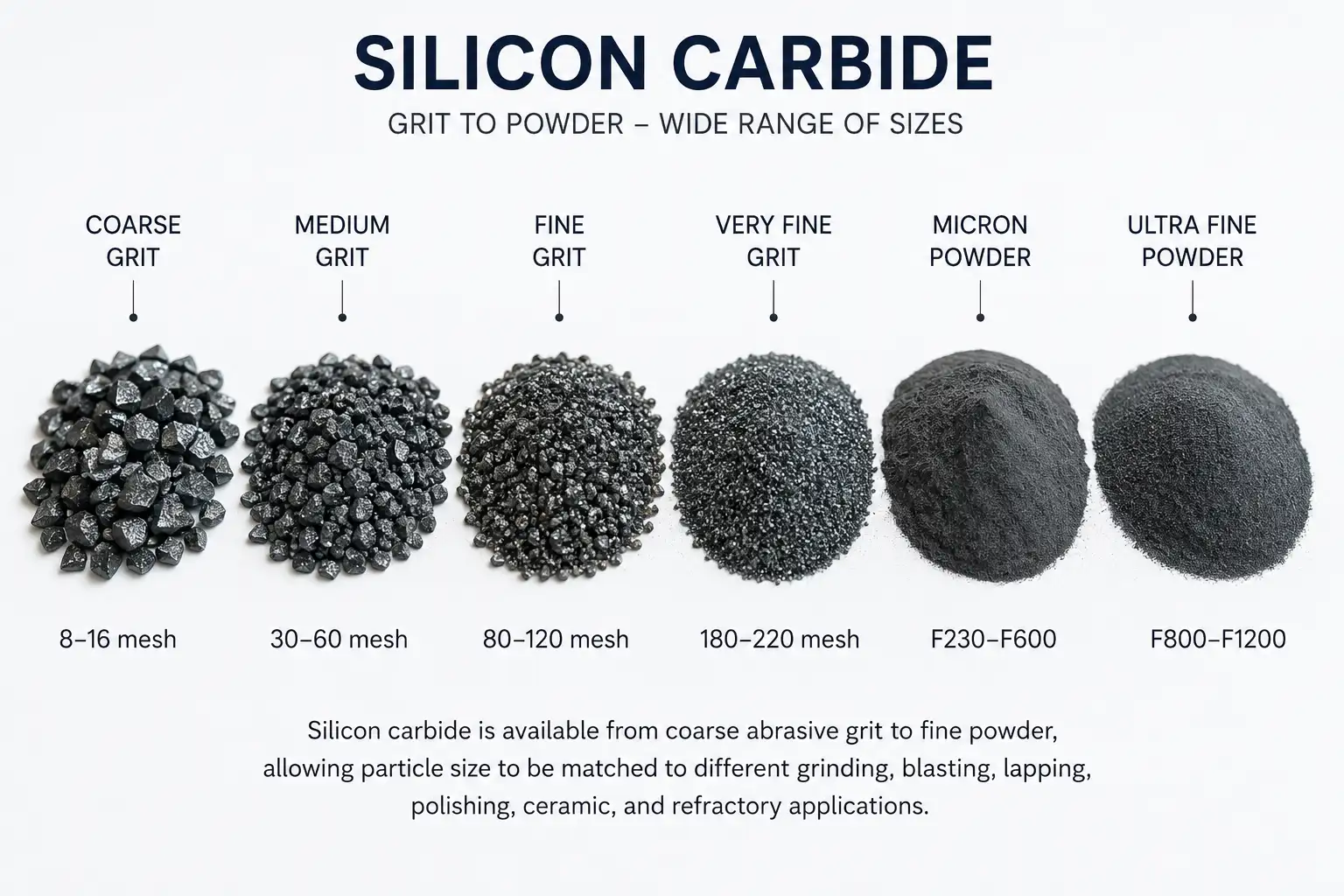
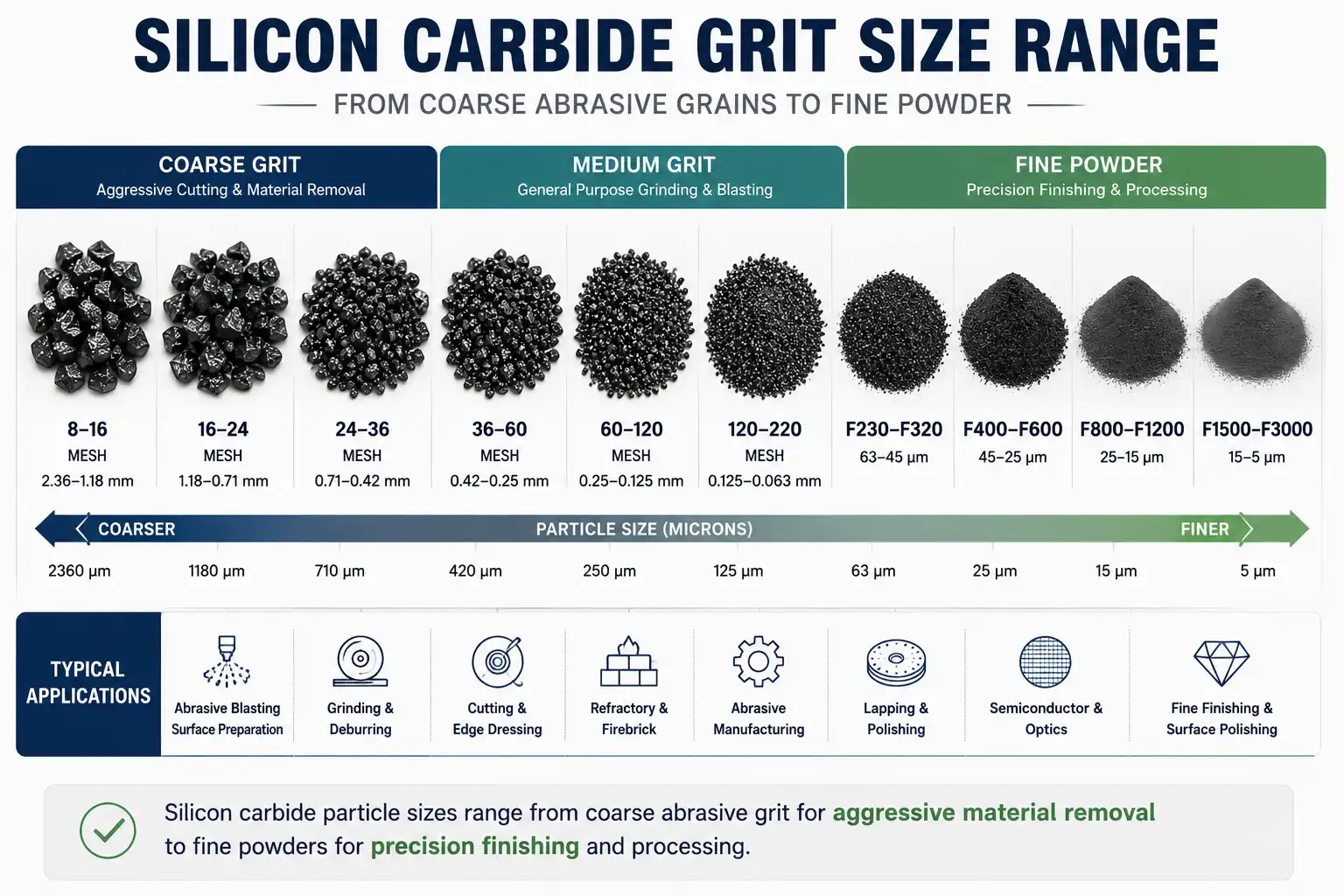
Silicon carbide is available across a wide range of particle sizes, from coarse abrasive grains used for aggressive material removal to fine powders used for lapping, polishing, ceramics, and precision surface processing.
For industrial buyers, the most important point is that a grit number is not simply a product name. It represents a defined particle-size range under a particular grading system. Therefore, the required standard should be confirmed when comparing specifications from different suppliers.
In general, lower grit numbers indicate coarser particles, while higher grit numbers indicate finer particles.
| General Range | Particle Character | Typical Applications |
|---|---|---|
| Coarse Grit | Large abrasive particles | Blasting, aggressive grinding, surface preparation |
| Medium Grit | Medium abrasive particles | Grinding, deburring, controlled surface finishing |
| Fine Grit | Smaller abrasive particles | Fine grinding, finishing, abrasive manufacturing |
| Fine Powder / Microgrit | Fine controlled particles | Lapping, polishing, ceramics, precision processing |
The exact boundary between “grit” and “powder” can vary depending on the industry, supplier, and grading system. For purchasing purposes, specifying the required standard and particle-size range is more reliable than relying only on terms such as coarse, fine, or powder.
For detailed individual sizes and approximate particle dimensions, see our Silicon Carbide Grit Size Chart.
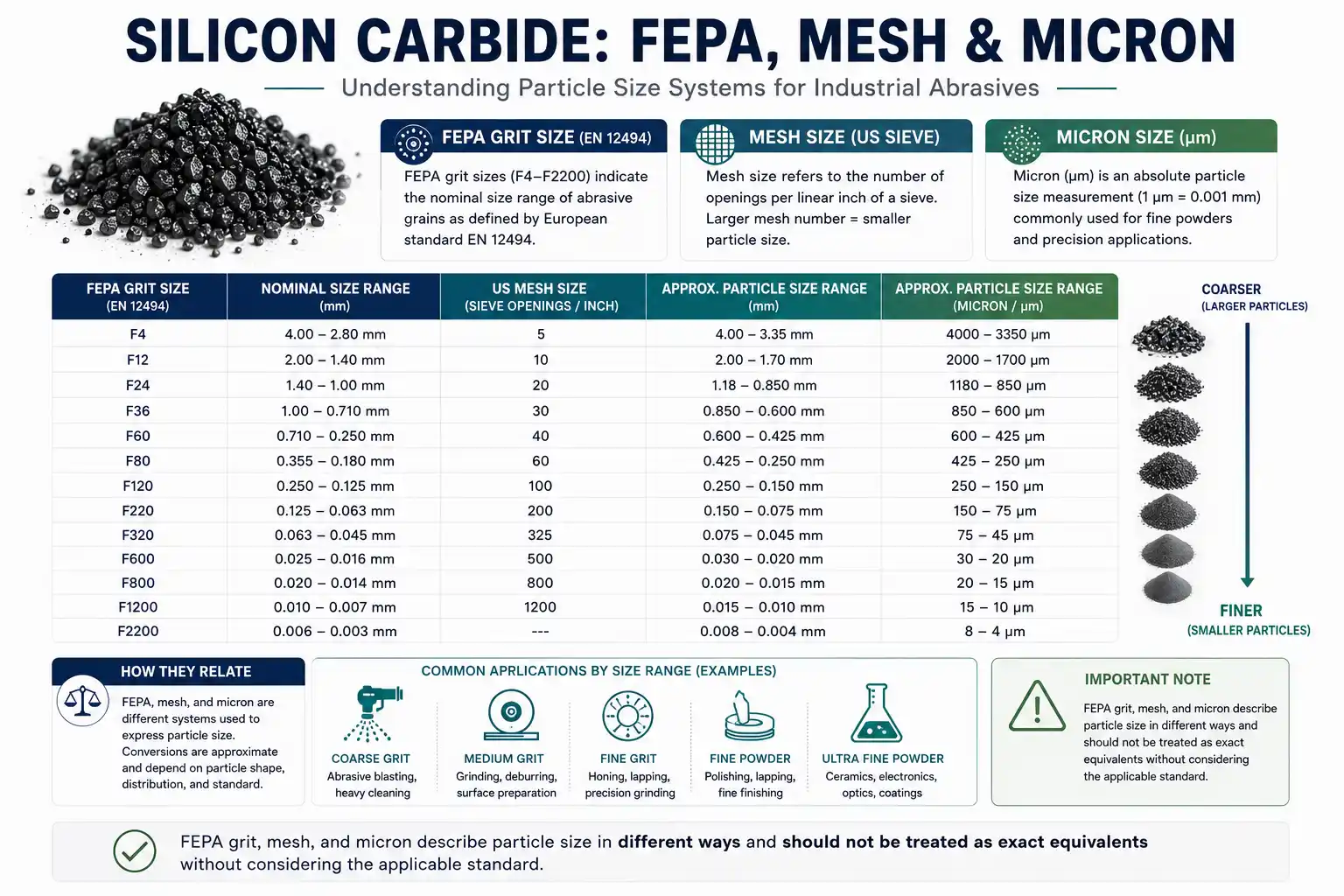
FEPA Grit, Mesh and Micron: What Do They Mean?
Silicon carbide particle size may be described using several different systems. Three terms frequently encountered by industrial buyers are FEPA grit, mesh, and micron.
These terms are related to particle size, but they are not interchangeable.
FEPA Grit
FEPA grit designations are commonly used for abrasive products. A designation such as F60, F120, or F400 identifies a defined abrasive grain size classification rather than simply describing the diameter of every individual particle.
This makes FEPA designations particularly useful when purchasing silicon carbide for abrasive manufacturing, grinding, and other standardized industrial applications.
Mesh
Mesh is traditionally associated with sieve classification. It describes the number of openings per linear inch of a screen, although the actual relationship between mesh designation and particle size also depends on the sieve standard and wire dimensions.
As a general concept, higher mesh numbers correspond to smaller openings and therefore finer particles.
Micron
A micron, or micrometer (µm), is a direct unit of length equal to one-thousandth of a millimeter. Micron-based specifications are particularly useful for fine powders and applications where particle-size control is important.
| System | What It Describes | Common Use |
|---|---|---|
| FEPA Grit | Standardized abrasive grain classification | Grinding and abrasive applications |
| Mesh | Sieve-based size classification | Industrial powders and granular materials |
| Micron (µm) | Direct particle dimension | Fine powders and precision processing |
A common purchasing mistake is to assume that grit, mesh, and micron values can always be converted using a single exact formula. In practice, the relationship depends on the grading standard and particle-size distribution.
When a process has strict particle-size requirements, buyers should request the applicable specification or particle-size distribution rather than relying only on an approximate conversion.
How to Choose Silicon Carbide Grit or Powder by Application
The best silicon carbide specification depends primarily on what the material needs to do in the customer's process. Starting with the application is often more effective than selecting a grit number first.
| Application | Typical Choice | Selection Priority | Application Guide |
|---|---|---|---|
| Abrasive Blasting | Silicon Carbide Grit | Cutting action, particle size, surface profile | Silicon Carbide for Sandblasting |
| Grinding | Silicon Carbide Grit | Grit size, material being ground, removal rate | Silicon Carbide for Grinding |
| Lapping | Fine Silicon Carbide Powder | Particle size, distribution, required finish | Silicon Carbide Powder for Lapping |
| Polishing / Fine Finishing | Fine Silicon Carbide Powder | Particle size and target surface finish | Silicon Carbide Powder for Polishing |
| Glass Processing | Grit or Powder | Processing stage and required finish | Silicon Carbide for Glass |
| Refractories | Grit and/or Powder | Composition, particle size, formulation requirements | Silicon Carbide for Refractories |
| Technical Ceramics | Fine Silicon Carbide Powder | Purity, particle size, processing requirements | Silicon Carbide Powder for Ceramics |
| Coated & Bonded Abrasives | Graded Silicon Carbide Grit | FEPA grade, grain type, abrasive performance | Silicon Carbide for Abrasives |
This application-first approach is especially useful for B2B purchasing because two customers requesting “silicon carbide F120” may still have very different requirements depending on whether the material will be used for grinding, blasting, bonded abrasives, or another process.
Which Silicon Carbide Should You Choose?
For most industrial buyers, silicon carbide selection can be narrowed down by answering four questions.
1. What Is the Application?
Start with the actual process: blasting, grinding, lapping, polishing, abrasive manufacturing, refractory production, ceramics, or another industrial application.
2. What Particle Size Do You Need?
Specify the required FEPA grit, mesh range, micron range, or other particle-size requirement. If the exact specification is unknown, the target surface finish or processing requirement can help determine an appropriate starting point.
3. Do You Need Black or Green Silicon Carbide?
Black silicon carbide is widely used for general industrial abrasive and refractory applications, while green silicon carbide is typically selected where higher purity or specific processing performance is required.
4. Are There Additional Technical Requirements?
Depending on the application, buyers may also need to specify chemical composition, particle-size distribution, bulk density, packaging, or other technical parameters.
For a faster quotation or technical recommendation, provide:
- Silicon carbide type: black or green
- Required grit / mesh / micron size
- Application
- Required quantity
- Packaging requirements
- Destination country or port
Explore Silicon Carbide Grit & Powder Resources
Use the guides below to explore individual silicon carbide topics in more detail.
What Is Silicon Carbide Grit?
Learn how silicon carbide grit is produced, classified, and used in industrial abrasive applications.
What Is Silicon Carbide Powder?
Understand fine silicon carbide powder, particle-size requirements, properties, and common applications.
Silicon Carbide Grit Size Chart
Compare silicon carbide grit sizes and understand FEPA, mesh, and micron particle-size terminology.
Silicon Carbide Grit vs. Powder
Compare particle size, applications, specifications, and purchasing considerations.
Silicon Carbide Grit Uses
Explore common uses of silicon carbide grit across blasting, grinding, abrasives, glass, and industrial processing.
Silicon Carbide Powder Uses
Explore applications of fine silicon carbide powder in lapping, polishing, ceramics, refractories, and precision processing.
Black vs. Green Silicon Carbide
Compare the properties, purity, applications, and selection considerations of black and green silicon carbide.
What Specifications Matter When Buying Silicon Carbide Grit or Powder?
For industrial purchasing, particle size is only one part of the silicon carbide specification. Two products described with the same grit designation may not necessarily be suitable for the same process if their chemistry, particle-size distribution, or other technical requirements differ.
Before requesting a quotation, buyers should identify the specifications that directly affect their application.
| Specification | Why It Matters | What Buyers Should Provide |
|---|---|---|
| Silicon Carbide Type | Black and green silicon carbide are suited to different performance and purity requirements. | Black SiC, Green SiC, or application details if uncertain |
| Particle Size | Controls cutting action, material removal, surface profile, and final finish. | FEPA grit, mesh, micron range, or required particle-size distribution |
| Chemical Composition | Some refractory, ceramic, and precision applications require tighter composition limits. | Required SiC content or technical specification |
| Particle-Size Distribution | Particularly important for fine powders, lapping, polishing, and precision processing. | PSD requirement or existing technical data sheet |
| Application | The same nominal particle size can perform differently depending on the process. | Blasting, grinding, lapping, polishing, refractory, ceramics, abrasives, etc. |
| Quantity | Influences packaging, production planning, and commercial quotation. | Sample quantity, trial order, or regular purchasing volume |
| Packaging | Industrial buyers may require standard bags, bulk packaging, pallets, or customized packaging. | Preferred packaging format |
If you are replacing an existing silicon carbide material, providing the current specification or technical data sheet can make product matching more efficient.
Silicon Carbide Grit or Powder: Quick Selection Guide
If you are unsure where to start, the following selection guide can help narrow the available options before reviewing a detailed technical specification.
| If You Need... | Start With... | Then Confirm... |
|---|---|---|
| Aggressive surface preparation | Coarser silicon carbide grit | Required surface profile and blasting process |
| Grinding hard or brittle materials | Graded silicon carbide grit | Workpiece material, grit size, and grinding process |
| Fine surface finishing | Fine silicon carbide grit or powder | Required final surface finish |
| Precision lapping | Fine silicon carbide powder | Particle size and particle-size distribution |
| Polishing | Fine or micro silicon carbide powder | Workpiece material and target finish |
| Refractory formulation | Black silicon carbide grit and/or powder | SiC content, particle-size distribution, and formulation |
| Technical ceramic processing | Fine silicon carbide powder | Purity and particle-size requirements |
| Coated or bonded abrasive production | Graded silicon carbide abrasive grain | FEPA grade and abrasive product requirements |
This table should be treated as a starting point rather than a universal specification. Final selection should always be based on the actual manufacturing process and technical requirements.
Common Questions About Silicon Carbide Grit & Powder
What is the difference between silicon carbide grit and silicon carbide powder?
The main practical difference is particle size and application. Silicon carbide grit generally refers to coarser graded abrasive particles used for grinding, blasting, surface preparation, and abrasive products, while silicon carbide powder generally refers to finer particles used for lapping, polishing, ceramics, and other precision applications.
Is silicon carbide grit the same as silicon carbide grain?
The terms are often used closely in the abrasive industry, but their exact meaning can depend on the supplier and application. For purchasing, the relevant grit standard and particle-size specification are more important than terminology alone.
What is silicon carbide powder used for?
Silicon carbide powder is used in applications including lapping, polishing, precision surface finishing, ceramics, refractories, composite materials, and other processes that require hard particles with controlled particle sizes.
See our Silicon Carbide Powder Uses guide for application-specific information.
What is silicon carbide grit used for?
Silicon carbide grit is commonly used for abrasive blasting, grinding, surface preparation, coated and bonded abrasives, glass and stone processing, refractory products, and other industrial abrasive applications.
See Silicon Carbide Grit Uses for a detailed application guide.
Which is finer: grit or powder?
Powder generally refers to finer silicon carbide particles, while grit generally refers to coarser graded abrasive particles. However, there is no universal terminology boundary that applies to every supplier and industry, so the actual particle-size specification should always be confirmed.
Does a higher grit number mean finer silicon carbide?
Within commonly used abrasive grading systems, higher grit numbers generally correspond to finer abrasive particles. However, buyers should use the applicable grading standard rather than assuming that grit numbers from different systems are directly equivalent.
How do I convert silicon carbide grit to microns?
Grit-to-micron values should be interpreted according to the applicable abrasive standard. They should not be treated as exact one-to-one conversions because abrasive grades represent controlled particle-size distributions rather than a single particle diameter.
Use our Silicon Carbide Grit Size Chart for detailed FEPA grit and particle-size information.
Should I choose black or green silicon carbide?
Black silicon carbide is widely used for general abrasive, grinding, blasting, refractory, and industrial applications. Green silicon carbide is generally selected when higher purity or specific precision-processing characteristics are required. The best choice depends on the application and technical specification.
Read Black vs. Green Silicon Carbide for a detailed comparison.
Explore Black & Green Silicon Carbide
After identifying the required particle size and application, the next step is selecting the appropriate silicon carbide grade.
Black Silicon Carbide
Explore black silicon carbide grit and powder for grinding, abrasive blasting, refractory materials, coated and bonded abrasives, and general industrial applications.
View Black Silicon CarbideGreen Silicon Carbide
Explore green silicon carbide grit and powder for higher-purity abrasive, precision grinding, fine powder, ceramic, and specialized industrial applications.
View Green Silicon CarbideNeed Help Selecting Silicon Carbide Grit or Powder?
If you already know the required specification, send us the silicon carbide type, particle size, quantity, packaging requirements, and destination for a quotation.
If you are not sure which grit or powder is suitable, provide the application, workpiece material, required surface finish, and current abrasive specification. Our team can help identify an appropriate starting specification for evaluation.
For faster technical evaluation, please include:
- Black or green silicon carbide, if known
- FEPA grit, mesh, micron range, or particle-size requirement
- Application
- Required quantity
- Packaging requirement
- Destination country or port
Silicon Carbide Grit & Powder: Final Takeaway
Silicon carbide grit and silicon carbide powder are not separate materials in the chemical sense; they are different particle-size forms of silicon carbide selected according to processing requirements.
Coarser silicon carbide grit is commonly associated with blasting, grinding, abrasive manufacturing, and aggressive surface processing. Finer silicon carbide powder is more commonly selected for lapping, polishing, precision finishing, ceramics, and applications where particle-size control becomes increasingly important.
For industrial purchasing, the most reliable approach is to select silicon carbide according to application, material type, particle size, grading standard, chemical requirements, and required surface result rather than choosing a product based only on the terms “grit” or “powder.”
This guide serves as the starting point for our silicon carbide grit and powder resources. Use the linked technical guides above for detailed information about grit sizes, particle-size systems, applications, and material selection.